Carlo Zimmermann · 2 October 2026
Visualizing Capsaicin Migration Patterns Through Infrared Optics During Multi-Stage Pepper Fermentation Workflows
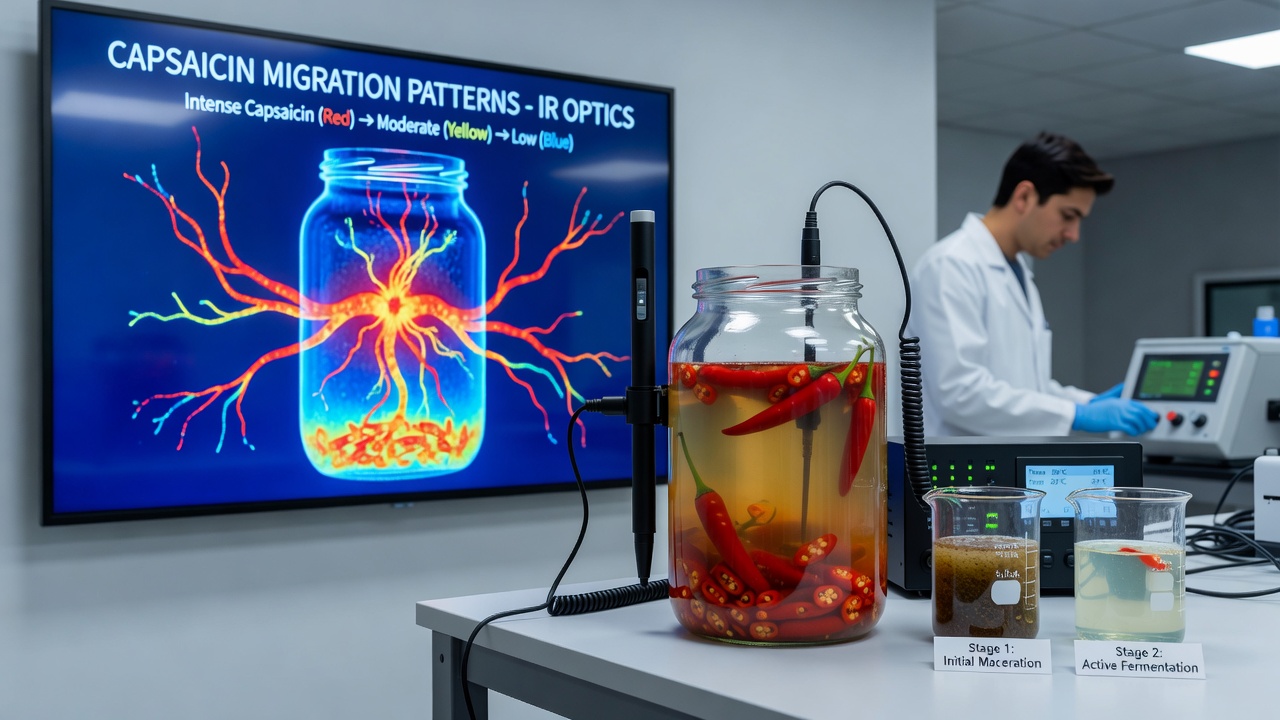
Researchers apply infrared optics to track capsaicin movement in peppers undergoing controlled fermentation across multiple stages, and this approach combines thermal imaging with chemical analysis to map how the compound shifts from pod interiors to surrounding brine over time. Studies indicate that capsaicinoids exhibit distinct absorption bands in the mid-infrared range, which allows specialized cameras to differentiate concentration gradients without physical sampling at every interval. Data from Agriculture and Agri-Food Canada shows consistent temperature differentials of 2 to 4 degrees Celsius between high-capsaicin zones and adjacent areas during active bacterial conversion phases.
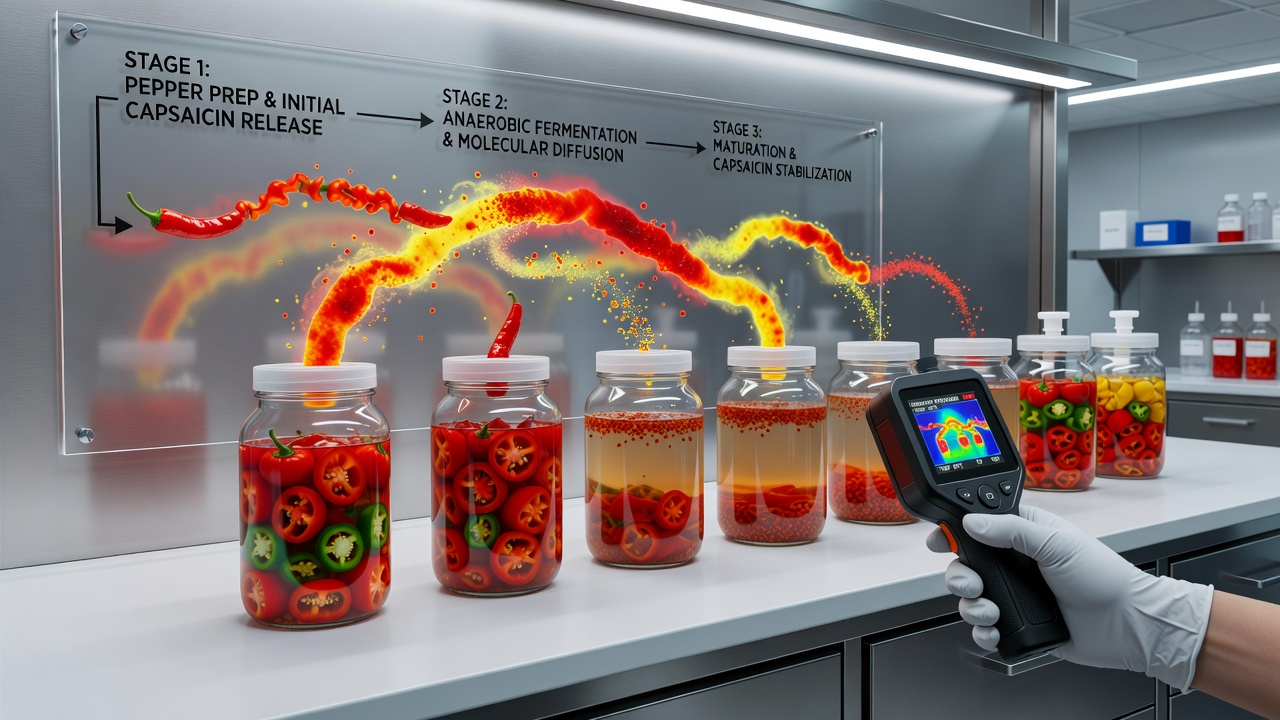
Multi-stage workflows typically begin with fresh pepper preparation where whole pods enter initial brining tanks held at 18 to 22 degrees Celsius for 48 hours, after which operators transfer material to secondary vessels for lactic acid development over the next five to seven days. Observers note that infrared systems positioned above each tank record sequential frames every 15 minutes, and software processes these frames to generate time-lapse visualizations of capsaicin fronts advancing outward from placental tissue. Those who have reviewed the resulting datasets report clear demarcation lines that sharpen during the first 72 hours before gradually diffusing as cell walls break down.
Optical Setup and Calibration Procedures
Technicians calibrate infrared cameras using reference samples of known capsaicin concentrations dissolved in simulated brine solutions, and this step ensures accurate mapping between pixel intensity values and actual milligram-per-kilogram readings. Equipment operates in the 8 to 14 micrometer wavelength window where capsaicin produces measurable emissivity changes, while fermentation vessels remain enclosed to maintain anaerobic conditions and prevent external thermal interference. Calibration routines run daily because ambient humidity fluctuations can alter lens transmission, and teams log each adjustment against standard curves derived from high-performance liquid chromatography cross-checks.
During the primary fermentation window, microbial activity generates localized heat that infrared optics distinguish from capsaicin-specific signals through dual-band filtering techniques. Experts have observed that pH drops from 6.8 to 4.2 correlate with accelerated capsaicin release rates, yet the compound itself does not degrade significantly until later maturation stages. Software algorithms subtract background thermal noise generated by bacterial metabolism, leaving clean migration overlays that highlight radial diffusion patterns from each pepper segment.
Observed Migration Dynamics Across Stages
In the initial brining phase capsaicin remains largely confined within placental membranes, yet small quantities begin leaching into the surrounding liquid within the first 12 hours according to frame analysis. By day three the compound forms distinct plumes that extend 8 to 12 millimeters beyond pod surfaces, and these plumes intensify as salt concentrations stabilize around 6 percent. Researchers document that secondary fermentation introduces additional variables including yeast activity and minor oxygen ingress during transfers, both of which influence how quickly capsaicin equilibrates throughout the vessel volume.
One documented workflow from a pilot facility in British Columbia tracked 200-kilogram batches through four sequential stages, and the infrared records revealed that 65 percent of total capsaicin had migrated into brine by the end of stage two while the remaining fraction stayed bound to solids until enzymatic softening completed. Those reviewing the footage note that agitation cycles every 48 hours temporarily accelerate visible fronts, after which patterns re-stabilize within four hours. Additional imaging sessions conducted in October 2026 incorporated hyperspectral extensions that further separated capsaicin signals from interfering volatiles produced during later maturation.
Data Integration and Workflow Adjustments
Operators integrate infrared outputs with real-time pH and temperature sensors to adjust brine circulation rates, and this closed-loop approach reduces batch-to-batch variability in final capsaicin distribution. Figures from CSIRO in Australia indicate that fermentation runs guided by optical feedback achieve 12 percent more uniform capsaicin concentrations across finished product lots compared with traditional timed protocols. Teams store the accumulated frame stacks in centralized databases where machine-learning models identify recurring migration signatures associated with specific pepper cultivars or brine formulations.
Advanced facilities now embed infrared cameras directly into tank lids, and this placement eliminates parallax errors that previously complicated three-dimensional reconstructions. Calibration against certified reference materials continues throughout each run because lactic acid accumulation slightly modifies infrared transmission properties of the brine matrix. Those managing commercial lines report that visualization data also supports regulatory documentation requirements by providing non-destructive evidence of compound behavior during processing.
Conclusion
Infrared optics applied to multi-stage pepper fermentation delivers continuous, non-invasive records of capsaicin migration that complement conventional laboratory assays. The technique maps spatial and temporal changes across entire vessel volumes while preserving anaerobic environments, and integration with process controls allows operators to refine timing and agitation parameters based on observed fronts. Continued refinement of dual-band filtering and hyperspectral additions promises higher resolution in future deployments, while existing datasets already support improved consistency in fermented pepper products across multiple production scales.