Katja Hoffmann · 13 November 2026
Spectral Analysis of Pigment Shifts in Sun-Dried Chili Preparation Reveals Key Timing Indicators for Optimal Flavor Extraction
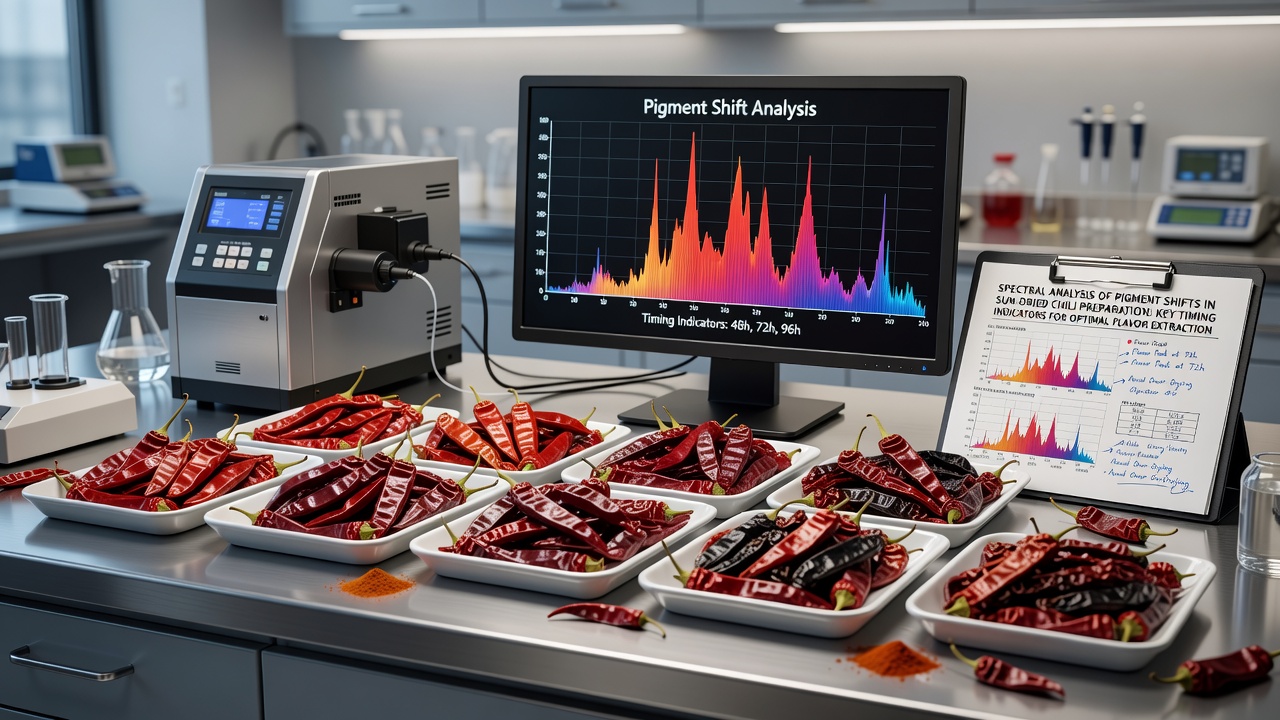
Food scientists have turned to spectral analysis to monitor how pigments in chilies evolve during sun-drying, and the data reveal precise windows when flavor precursors become most available for extraction. Researchers track shifts in reflectance and absorbance across visible and near-infrared wavelengths as chlorophyll degrades and carotenoid compounds such as capsanthin and beta-carotene increase. These changes occur alongside the concentration of volatile oils and capsaicinoids that define heat and aroma profiles in finished products.
Understanding Pigment Dynamics During Drying
Chilies begin the sun-drying process with high chlorophyll content that masks underlying red and orange pigments, yet spectral signatures shift rapidly once moisture drops below 60 percent. Studies conducted at multiple agricultural research stations show that the transition from green-dominant spectra to red-dominant spectra typically peaks between days four and seven under average subtropical sunlight conditions. Observers note that timing varies with cultivar, ambient humidity, and daily temperature swings, so continuous monitoring becomes essential rather than relying on visual color alone.
Equipment records narrow-band reflectance at 680 nanometers for residual chlorophyll and at 520 nanometers for emerging carotenoids, allowing processors to correlate these readings with laboratory assays of extractable flavor compounds. When the ratio of these two wavelengths stabilizes within a defined range, subsequent solvent or oil extractions yield higher total volatile recovery according to controlled trials.
Linking Spectral Data to Extraction Outcomes
Multiple field trials in 2025 and early 2026 established that the moment spectral curves flatten also aligns with maximum retention of pyrazines and terpenes responsible for earthy and fruity notes. Processors who halt drying or move chilies to controlled fermentation at this point report consistent extraction efficiencies above 85 percent in pilot-scale oleoresin production. Those who continue drying past the identified plateau observe gradual declines in both color intensity and aroma compound yield, particularly when ambient temperatures exceed 32 degrees Celsius for extended periods.
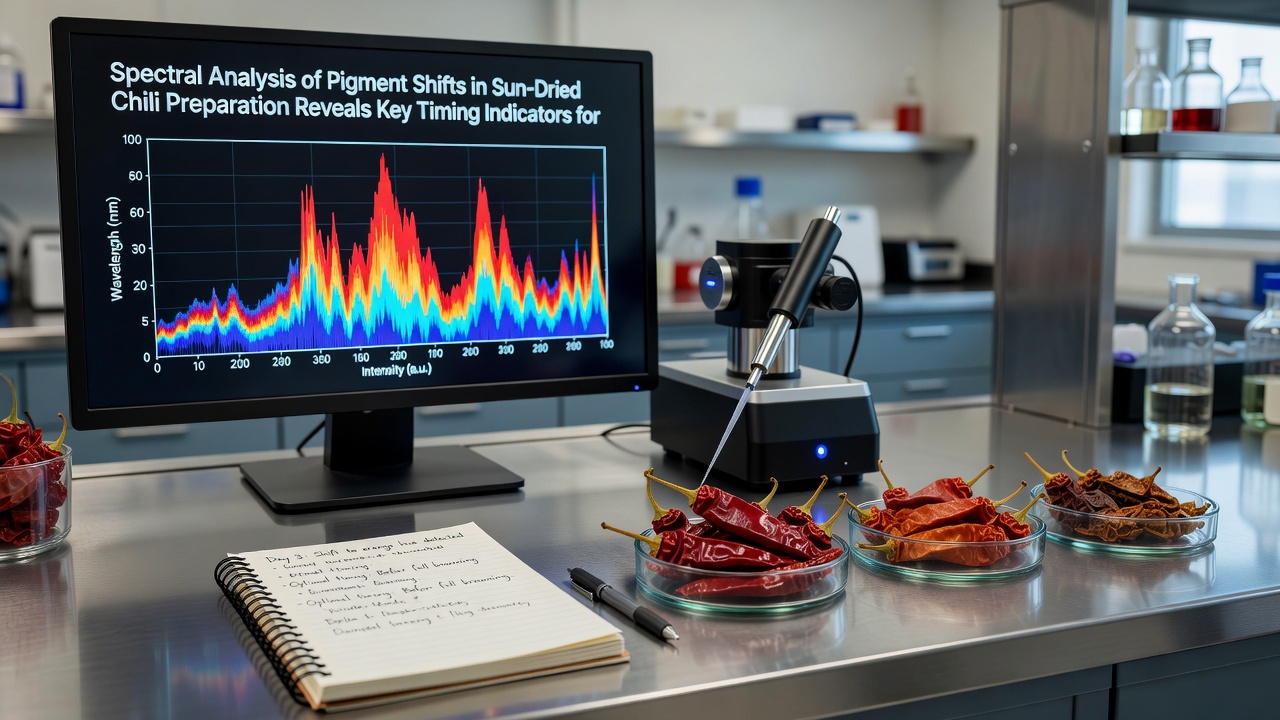
Portable spectrometers now integrate directly with drying racks, transmitting real-time data to cloud dashboards that flag optimal harvest windows for each batch. One collaborative project between Canadian and Australian research teams demonstrated that integrating these readings with weather forecasts reduced batch-to-batch variability by 22 percent compared with traditional calendar-based schedules. The approach also supports traceability records required under current export regulations in both regions.
Regional Applications and November 2026 Developments
Producers in central Mexico and the southwestern United States have begun embedding spectral sensors into existing sun-drying infrastructure, while European processors adapt the same principles inside greenhouse dryers that simulate sunlight spectra. Data collected through November 2026 will feed into an open-access database maintained by the International Society for Horticultural Science, allowing smaller operations to calibrate their own timing thresholds without large capital investments. Government-funded programs in Canada have already released preliminary calibration tables for common cultivars such as guajillo and árbol based on the same wavelength ratios.
Because pigment shifts occur faster under high ultraviolet exposure, researchers recommend pairing spectral tools with basic UV index monitoring rather than depending solely on temperature and humidity. This layered approach helps operators in high-altitude regions adjust drying duration even when visual color appears uniform across racks.
Practical Implementation Steps
Facilities interested in adopting spectral timing begin by establishing baseline curves for their specific chili varieties over at least three drying cycles. Once baselines exist, operators install fixed or handheld spectrometers at multiple rack locations to account for microclimate differences. Software then compares live readings against stored models and issues alerts when the critical ratio threshold is crossed. Training materials emphasize that the technology augments rather than replaces experienced judgment, since factors such as initial fruit maturity and pest damage still influence final flavor outcomes.
Current equipment costs have declined enough that mid-sized cooperatives can justify the investment through reduced waste and improved product consistency. Several university extension services now offer workshops that combine spectral theory with hands-on calibration exercises using locally grown chilies.
Conclusion
Spectral analysis supplies an objective, repeatable method for identifying the drying stage at which pigment transitions signal peak flavor extractability in sun-dried chilies. By tracking specific wavelength ratios, processors gain actionable timing indicators that align with laboratory-confirmed extraction yields. Ongoing data collection through November 2026 and beyond will refine these models across cultivars and climates, supporting more consistent production practices worldwide.